AML Laws and Regulations for Payment Service Providers in Singapore
In a Nutshell
A payment service provider is a holder of a payment services licence under the Payment Services Act 2019, or a person exempt under that Act, that carries on a specified payment service: account issuance, domestic money transfer, cross border money transfer, or money changing. E-money is reached through the connected product rules.
The central rulebook is MAS Notice PS N01 and its Guidelines. They set the risk based approach, customer due diligence, beneficial ownership, enhanced measures for politically exposed persons, correspondent and agency arrangements, the wire transfer travel rule, record keeping and suspicious transaction reporting.
The sector moves money quickly, often in cash and across borders, so it is exposed at both the placement and the layering stages. Singapore’s 2024 assessments rate payment institutions that offer cross border money transfer as medium high for money laundering and treat money remittance as one of the highest terrorism financing risks.
Around this core sit the criminal and sanctions statutes, the national risk assessments, the Payment Services Act that licenses the sector, and the FATF standards. This guide takes each instrument in turn, in plain language, and pins it to the exact source it comes from.
AML Laws and Regulations for Payment Service Providers in Singapore
A payment service provider moves other people’s money, often as cash at one end and a cross border transfer at the other, and that is precisely the kind of flow criminals use to place and move illicit funds. This guide sets out the laws and regulations that apply to a licensed provider of payment services in Singapore, the statutes that make money laundering an offence, and the detailed rulebook the Monetary Authority of Singapore (MAS) enforces.
This is best read as a layered framework. The criminal and sanctions laws sit at the form the base of the framework. Above them is the instrument a provider works with every day, MAS Notice PS N01, together with its Guidelines. Alongside these run Singapore’s national risk assessments, the Payment Services Act that licenses the sector, and the FATF standards behind the whole regime.
A remittance or money changing business often takes in physical cash and sends value abroad, the sector is susceptible to being used to place funds as well as to layer them, which is a wider exposure than a purely account based institution faces. That single fact drives much of what follows, from how a provider assesses risk to how it applies the travel rule to a cross border wire transfer.
Singapore's Payment Services Sector at a Glance
As at end 2023, there were close to 210 cross border money transfer service providers licensed in Singapore, a sector that has stayed relatively stable in number over recent years (Money Laundering National Risk Assessment 2024, chapter 7.5).
The sector is highly diverse, ranging from small money changers and remittance shops to large multinational payment institutions, and much of the cross border money transfer business remains cash intensive (ML NRA 2024).
Risk ratings: payment institutions offering cross border money transfer are assessed medium high for money laundering, and money remittance is assessed as high risk for terrorism financing, with unlicensed remittance rated as high for terrorism financing (ML NRA 2024; TF NRA 2024).
Core AML Laws and Regulations for Payment Service Providers in Singapore
These statutes and sanctions regulations make money laundering, terrorism financing and proliferation financing offences and require every payment service provider to detect and report them. They apply directly; MAS provides notice details on them, and the sector rulebook is built on top.
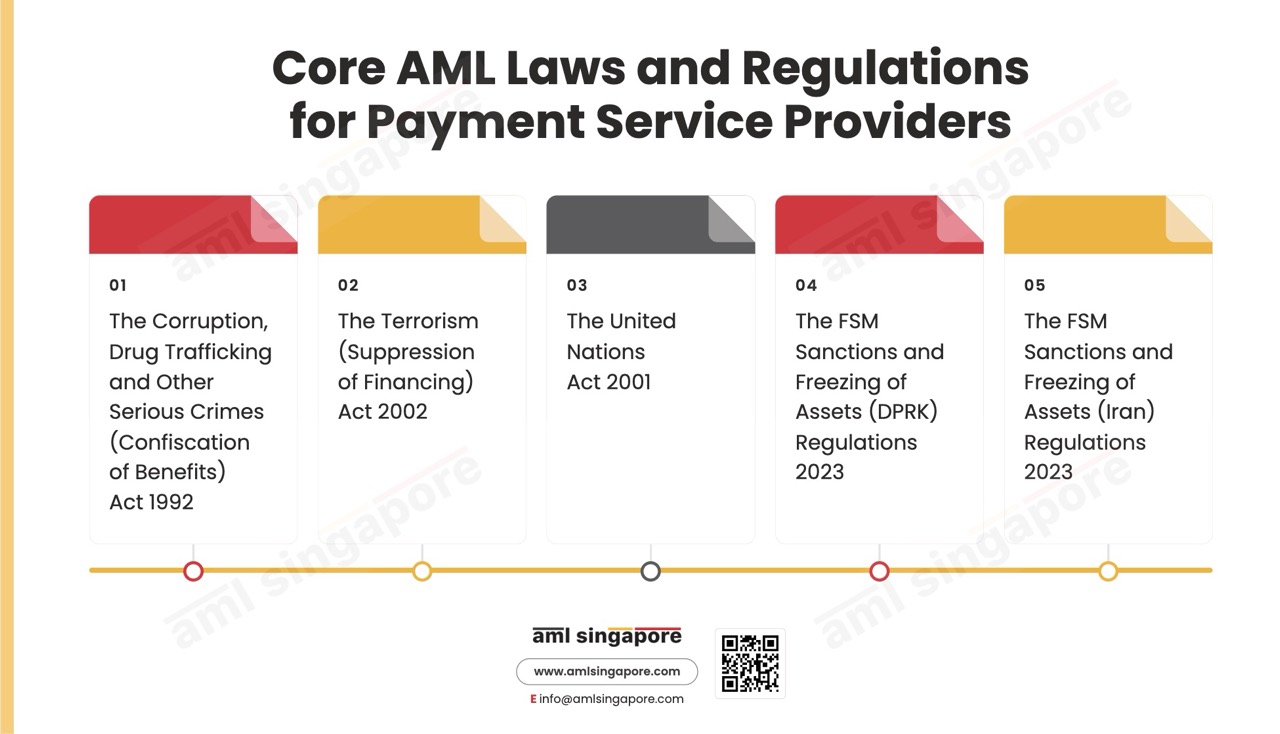
The Corruption, Drug Trafficking and Other Serious Crimes (Confiscation of Benefits) Act 1992
The CDSA establishes offences relating to money laundering and provides for the confiscation of benefits derived from drug dealing and criminal conduct. For a payment service provider, section 45 is particularly important because it requires a person who knows or has reasonable grounds to suspect that property may be connected with criminal activity to disclose that information to the Suspicious Transaction Reporting Office. Section 57 also creates an offence of tipping off, making it important for payment service providers to ensure that customers are not informed about suspicious transaction reports or related disclosures.
The Terrorism (Suppression of Financing) Act 2002
The TSOFA prohibits the collection or provision of property for terrorist acts and the use, possession or dealing of terrorist property. Section 8 requires persons who have possession, custody or control of terrorist property, or information concerning transactions involving such property, to immediately inform the Commissioner of Police. The Act also contains provisions addressing the disclosure of terrorism financing information and tipping off. For a payment service provider, these requirements are particularly relevant where transfers or payment accounts may involve terrorist property or terrorism financing.
The United Nations Act 2001
The United Nations Act provides the statutory power for Singapore to give effect to measures adopted by the United Nations Security Council under Article 41 of the UN Charter. Section 2 allows regulations to be made to implement such measures. However, financial institutions are excluded from the application of those measures to the extent that they are or may be subject to directions or regulations issued by MAS under the Financial Services and Markets Act 2022. For payment service providers, applicable UN sanctions are therefore implemented principally through the MAS sanctions and freezing framework.
The Financial Services and Markets (Sanctions and Freezing of Assets of Persons, Democratic People's Republic of Korea) Regulations 2023
These Regulations are made by MAS under the Financial Services and Markets Act 2022 and implement financial sanctions relating to the Democratic People’s Republic of Korea. They apply to financial institutions within the meaning of the Act and impose restrictions on specified financial services, transfers, transactions and activities connected with DPRK related proliferation and other prohibited activities. They also require assets of designated persons and specified entities to be frozen and impose information sharing obligations. Payment service providers must therefore maintain controls capable of identifying and preventing prohibited transactions and implementing applicable asset freezes.
The Financial Services and Markets (Sanctions and Freezing of Assets of Persons, Iran) Regulations 2023
The 2023 Iran Regulations implement UN Security Council Resolution 2231 and apply to every financial institution within the meaning of the FSM Act. They require freezing of assets of designated persons and prohibit certain financial assistance, services and transfers involving specified persons and designated items. They are not simply general Iran sanctions requiring every payment provider to screen every sender and beneficiary daily.
We handle AML regulatory reporting for payment service providers, so filings reach STRO and MAS accurately and on time.
Overarching AML Laws and Regulations Applicable to Payment Service Providers in Singapore
These instruments cut across the whole regime and give a provider the practical means to discharge its reporting duties and to recognise terrorism financing when it surfaces in a transfer or a cash transaction.
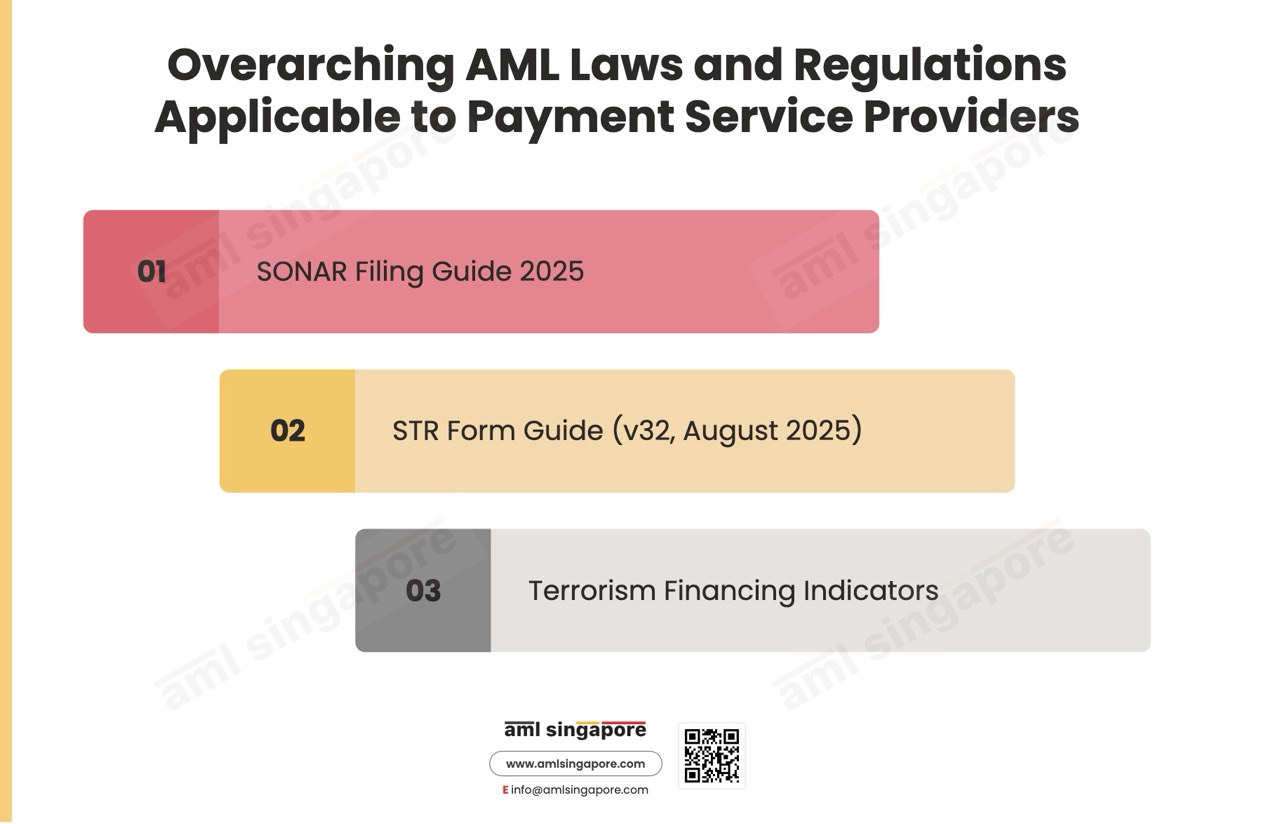
Getting Started with SONAR, for STR Filers (2025)
SONAR is the STRO Online Notices and Reporting platform through which businesses and their employees electronically submit suspicious transaction reports to the Suspicious Transaction Reporting Office. For a payment service provider, SONAR is the principal electronic filing channel for STRs.
Form Guide for the STR Form (Version 12 August 2025)
This guide explains how to complete the electronic suspicious transaction report form submitted through SONAR. It provides field level instructions covering information such as the reporting institution, parties to the transaction, grounds for suspicion and other information required for an effective STR. The current form guide is dated 12 August 2025.
Terrorism Financing Indicators
This guide explains how to complete the electronic suspicious transaction report form submitted through SONAR. It provides field level instructions covering information such as the reporting institution, parties to the transaction, grounds for suspicion and other information required for an effective STR. The current form guide is dated 12 August 2025.
National Risk Assessments Applicable to Payment Service Providers in Singapore
Singapore’s national risk assessments identify the country’s principal money laundering, terrorism financing and proliferation financing threats and vulnerabilities. Payment service providers should consider the relevant findings when assessing and managing their own ML and TF risks. MAS Notice PSN01 requires payment service providers to ensure that their risk mitigation measures address risk assessments and guidance from MAS and other relevant authorities in Singapore.
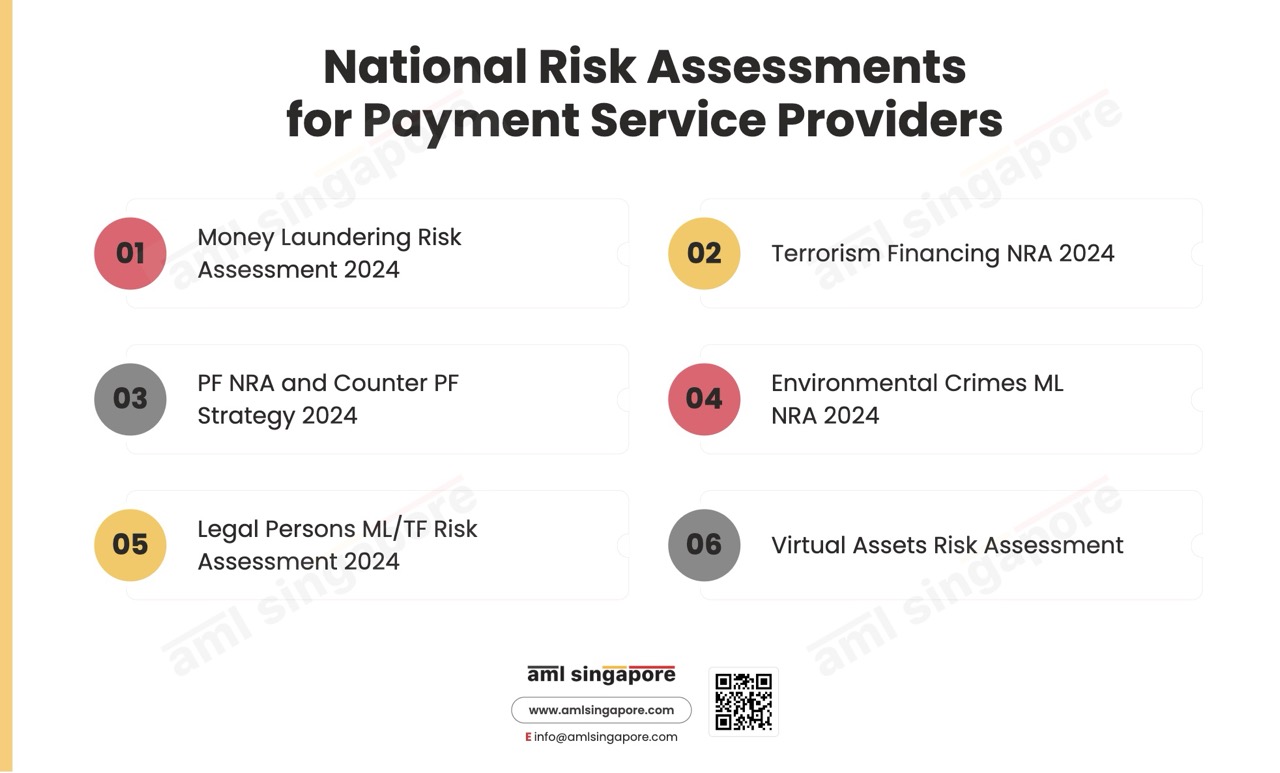
Money Laundering National Risk Assessment Singapore 2024
The 2024 national money laundering risk assessment identifies cross border money transfer services as an important area of money laundering exposure. Payment service providers should consider the risks identified in the assessment when evaluating their own customer, product, geographic and transaction risks, particularly where their services facilitate cross border movement of funds.
Terrorism Financing National Risk Assessment 2024
The 2024 Terrorism Financing National Risk Assessment identifies money remittances and payment service providers carrying out cross border money transfer services as inherently vulnerable to terrorism financing threats. For a payment service provider, the assessment is relevant to customer due diligence, transaction monitoring and the identification of terrorism financing indicators, particularly in cross border payment activity.
Proliferation Financing National Risk Assessment and Counter PF Strategy 2024
The Proliferation Financing National Risk Assessment identifies the principal proliferation financing threats and vulnerabilities facing Singapore and the measures used to mitigate them. For payment service providers, the assessment is relevant to risks involving sanctions evasion, opaque ownership structures, higher risk jurisdictions and cross border transactions that may support proliferation related activities. The findings should inform the provider’s risk assessment, sanctions controls and transaction monitoring.
Environmental Crimes Money Laundering National Risk Assessment (May 2024)
The Environmental Crimes Money Laundering National Risk Assessment examines the money laundering threats and vulnerabilities associated with environmental crimes, including illegal wildlife trade and illegal logging. It is relevant to payment service providers because illicit proceeds from environmental crimes may be moved through financial and payment channels, including cross border transactions. The assessment can therefore inform the identification of environmental crime related risks and transaction monitoring scenarios.
Money Laundering and Terrorism Financing Risk Assessment of Legal Persons (2024)
The 2024 assessment examines the money laundering and terrorism financing risks associated with legal persons in Singapore. It is relevant to payment service providers because corporate customers can be misused to conceal beneficial ownership, hold or move illicit funds and structure transactions. Providers should therefore apply appropriate customer due diligence and beneficial ownership measures when onboarding and monitoring legal person customers.
Virtual Assets (Digital Payment Tokens) Risk Assessment (2024)
The Virtual Assets Risk Assessment examines Singapore’s exposure to money laundering, terrorism financing and proliferation financing risks associated with virtual assets. It is relevant to payment service providers where their customers or transactions interact with digital payment token activities or virtual asset ecosystems. The assessment can help providers identify higher risk virtual asset related activity and strengthen customer due diligence, transaction monitoring and risk mitigation measures where appropriate.
Payment Services Sector ML/TF risk Snapshot
Cross border money transfer: medium high money laundering risk, given cash intensity, cross border reach and the use of remittance to move proceeds overseas (ML NRA 2024, chapter 7.5).
Money remittance: among the highest terrorism financing risks, with unlicensed remittance rated high and new cross border fast payment systems flagged as emerging (TF NRA 2024).
Money changing: cash intensive, with placement risk where large or structured cash is exchanged; managed through thresholds and aggregation rules.
Account issuance, e-money and domestic transfer: lower inherent risk, subject to the low value exemptions in the Notice but not risk free where accounts are misused for third party flows.
MAS expects an enterprise-wide ML/TF risk assessment. We build one around your products, agents and corridors.
Sector-Specific Guidance Applicable to Payment Service Providers in Singapore
This is the core of a provider’s obligations, and it consists of common law, circulars and guidelines applicable to financial institutions, including payment service providers.
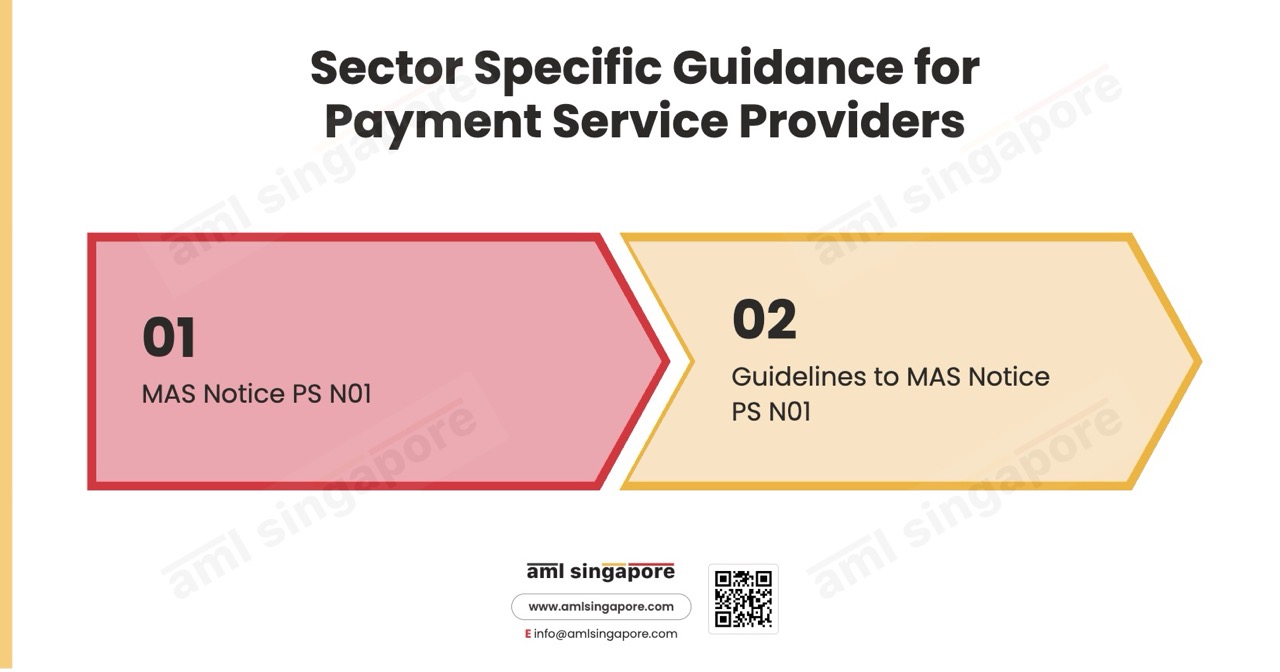
Common Law and Guidelines for Payment Service Providers
This common law, along with the MAS instruments, applies across financial institutions, including payment service providers and shapes how they design their controls.
The Financial Services and Markets Act 2022
The FSM Act 2022 is the law through which MAS conducts AML/CFT supervision and enforcement across the financial sector. It authorises the sanctions regulations a payment service provider screens against, and it gives MAS its inspection and direction powers over the sector.
Circular AMLD 01/2018: Use of MyInfo and CDD for Non Face to Face Business Relations
MAS recognises the Government’s MyInfo service as a reliable and independent source of a customer’s core identity data. Where an e-wallet or remittance app onboards a MyInfo user, the provider may verify from that data instead of collecting fresh documents, provided it applies the circular’s safeguards, including the extra measures expected when a customer is onboarded without using MyInfo.
Circular AMLD 01/2022: Non Face to Face Customer Due Diligence Measures
Building on the earlier MyInfo circular of 2018, this one sets MAS’s expectations for onboarding people and entities remotely, the default in app based wallets and digital remittance. It cautions that a video or selfie check on its own may fall short, suggests a second, independent channel for higher risk accounts, and expects the firm to assess any onboarding technology and have its board and senior management approve it.
Circular AMLD 02/2023: ML/TF Risks in the Wealth Management Sector
This circular reaches a payments firm that handles large or corporate cross border sums. MAS asks for firmer board oversight, review of due diligence and quality assurance, and looking through trusts and holding vehicles to the real beneficial owners.
Circular AMLD 08/2024: Establishing the Sources of Wealth of Customers
This circular explains how a firm should pin down a customer’s source of wealth before business begins. A provider is expected to take reasonable steps to establish it, to corroborate it against independent documents or sources under the tests of materiality, prudence and relevance, and to escalate what it cannot stand up. For a payments firm, the trigger is usually a customer funding transfer that is out of proportion to a known profile.
Circular AMLD 05/2026: Risk Proportionate Source of Wealth Establishment
A 2026 recalibration of the source of wealth expectations. MAS presses firms to keep the work effective, efficient and proportionate, so legitimate customers are not put through needless friction. A payments firm should train its corroboration on material or higher risk wealth, spare low value retail users repeated or excessive demands, and reserve escalation for genuine red flags instead of holding everyone to a single blanket standard.
Circular AMLD 11/2023: Ensuring Effective Detection of Sanctions Related Risks
MAS requires firms to detect and manage sanctions risk, including unilateral sanctions imposed by other jurisdictions that bear on cross border payment flows. The board must set the risk appetite, and the circular describes a lookback review of transactions after a designation, so a provider can catch value that moved through transfers and correspondents before a name was listed.
Circular AMLD 12/2024: Audit of AML/CFT Policies, Procedures and Controls
This circular outlines the requirement for an independent audit of AML/CFT policies, procedures and controls. A payments firm must keep an audit function that regularly tests whether its AML/CFT controls actually work, staff it with the right expertise, train it first on the higher risk areas, cross border transfers and oversight of agents.
Strengthening AML/CFT Controls on Misuse of Legal Persons and Complex Structures (August 2023)
Drawn from inspections, this MAS paper describes firms that allowed worrying flows to pass through trusts, foundations and stacked corporate layers. Its case studies expose two failures: not pinning down the true beneficial owner and not joining the dots on source of wealth concerns. A payments firm onboarding corporate senders or beneficiaries should measure itself against it and fix gaps under senior management oversight.
AML/CFT Supervisory Expectations from Recent Inspections (October 2024)
This inspection based paper sets out MAS’s expectations under five headings: reading multiple nationalities and investment migration links as risk factors, identifying document red flags, stress testing the plausibility of a customer’s source of wealth, following a report or an exit with real mitigation, and sharing customer information across business lines. For a payments firm, each heading translates into its onboarding and transaction review routines.
Best Practices in Relation to Risks in Wealth Management (May 2025)
An industry paper for firms serving wealthy clients, consolidating case studies on private investment companies, sanctions and geopolitical events, and remote onboarding. It is relevant to a payment service provider handling high value cross border transfers for such customers, and it confirms that when an intermediary sits between the firm and the end customer, the firm must still satisfy its due diligence obligations on that end customer.
Effective Practices to Detect and Mitigate the Risk from Misuse of Legal Persons (June 2019)
This MAS paper is about guarding against shell and front companies at every stage of the relationship. It offers multi factor risk assessment, red flag lists, network link analysis and staff training, and it warns that one red flag on its own rarely settles the matter. A payments firm onboarding corporate customers should analyse several signals together before it acts on a transfer instruction.
Guidance for Effective AML/CFT Transaction Monitoring Controls (September 2018)
MAS gathers its inspection based expectations for transaction monitoring. The paper covers how to calibrate parameters and thresholds to risk, back testing, data integrity, the handling and documentation of alerts, and the treatment of outsourced first level review. In a high volume payments operation, it warns particularly against clearing alerts on boilerplate grounds without checking that the underlying risk is truly dealt with.
Guidance to Capital Markets Intermediaries on Enhancing AML/CFT Frameworks and Controls (January 2019)
This guidance is for capital markets intermediaries, but its key takeaways are to be adjusted for payment firms and implemented accordingly. This MAS guidance on governance, risk awareness and execution binds a payment service provider. For other providers, it is persuasive good practice on board accountability.
Guidelines on Risk Management Practices, Internal Controls (July 2024)
A guideline setting out what MAS expects of a firm’s control environment and business process controls. It addresses customer due diligence only lightly and points to the AML/CFT notices and guidelines for the substance, so for a payments firm it supplies the internal controls frame, from segregation of duties to management reporting, on which the AML/CFT programme hangs rather than being a source of AML duties itself.
Guidelines on Provision of Digital Advisory Services (October 2018)
A conduct guideline for digital or robo advisory services, a capital markets activity rather than a payment service. It touches a payments firm only where the same entity also gives automated investment advice. Its AML/CFT footprint is small. The points is that any remote channel still needs adequate ML/TF controls and must manage the impersonation risks that come with onboarding a customer who is never seen in person.
Sound Practices to Counter Proliferation Financing (August 2018)
From MAS’s thematic reviews, this paper addresses proliferation financing linked to DPRK and Iran sanctions evasion. It sets out how firms should raise their controls, watch higher risk customers and counterparties more closely, and recognise typologies such as shell companies fronted by nominee directors. It bears on a payments firm because a cross border transfer can be layered to hide a designated party behind an intermediary.
Strengthening Financial Institutions' CFT Controls (May 2023)
Built on an industry survey, this MAS information paper focuses on countering the financing of terrorism. It repeats the duty to freeze and report designated party assets and sets expectations for screening, data analytics, escalation and prompt, good quality reporting, each of which a payments firm applies to its customers and to the senders and beneficiaries moving through the transfers it processes.
Specific Guidelines for Payment Service Providers
This is the core of a provider’s obligations. MAS is the supervisory authority for payment service providers and issues the notices and guidance they must follow.
MAS Notice PS N01 on Prevention of Money Laundering and Countering the Financing of Terrorism, Holders of Payment Services Licence, Specified Payment Services
Notice PS N01 is the binding AML/CFT rulebook for the sector. It applies to every holder of a payment services licence that carries on a specified payment service, and to persons exempt under the Payment Services Act who offer a specified product. The specified payment services include account issuance, domestic money transfer, cross border money transfer and money changing.
The Notice carves out low value business. Where a provider offers an exempted product, for example an account that cannot be used to withdraw cash and holds no more than S$1,000, or a domestic transfer funded from an identifiable source, most of the substantive obligations do not apply to that product. Outside those carve outs, the Notice sets the risk based approach. This implies that a provider must identify, assess and understand its money laundering and terrorism financing risk across its customers, the countries it deals with, its products and its channels, and must apply enhanced measures where risk is higher, assessing new products and technologies before launch.
Customer due diligence is the core. A provider must perform customer due diligence when it establishes business relations, when it effects or arranges a cross border wire transfer or a cross border money transfer for a customer who is not already in a business relationship, when it undertakes any occasional transaction above S$5,000 for such a customer (other than certain money changing transactions funded from an identifiable source), when it suspects money laundering or terrorism financing, or when it doubts information it holds.
If transactions look deliberately broken up to stay under a threshold, the provider must aggregate and treat them as one. It must identify and verify the customer from reliable, independent sources, identify any person acting for the customer, identify connected parties of a legal person, and identify and verify beneficial owners, the natural persons who ultimately own or control the customer.
Simplified due diligence is applicable only where risk is demonstrably low. For certain low value cross border wire transfers used solely as payment for goods or services from an identifiable source or for financial institutions’ customers listed in Appendix 2 of this notice.
Enhanced due diligence is mandatory in cases of politically exposed persons, requiring senior management approval, establishment of source of wealth and source of funds, and enhanced monitoring, and for other high risk situations.
The Notice adds obligations shaped by the sector’s mechanics: foreign currency exchange transactions of S$20,000 or more must undergo customer due diligence, with the background and purpose of the transaction inquired into and documented; there are restrictions on issuing bearer negotiable instruments and on paying out cash of S$20,000 or more.
A provider may rely on a qualifying third party but remains responsible for its AML/CFT obligations; correspondent account relationships with other financial institutions require suitability assessments and senior management approval, and where a firm operates through agents, it must include them in its AML/CFT programme and monitor them for compliance.
The wire transfer chapter is the sector’s signature obligation. Before effecting or arranging a wire transfer, the ordering institution must identify the originator and record enough detail to reconstruct the transfer.
For cross border transfers amounting to S$1,500 or less, it must include the names and account or reference numbers of both the originator and the beneficiary; for cross border transfers above S$1,500, it must also verify the originator’s identity and add the originator’s address, identification number, or date and place of birth.
Batched transfers must stay traceable, and an intermediary or beneficiary institution has its own duties, including adopting policies for when to execute, reject, or suspend a transfer that lacks the required information. Records must be kept for at least five years, suspicions must be reported to the Suspicious Transaction Reporting Office through a single internal reference point, mindful of the tipping off offence in section 57 of the CDSA, and the provider must maintain internal policies, a compliance officer, independent audit and training.
Guidelines to MAS Notice PS N01 (The Primary Guidance for Payment Service Providers)
These Guidelines serve as the primary guidance for payment service providers covered under Notice PS N01. MAS makes clear that how far a firm observes them can feed into its overall view of the firm, including how well its board and senior management exercise oversight.
The Guidelines open by explaining the sector and its risk. Payment services may move value, frequently in cash at the counter and then across borders, and the customer is usually onboarded remotely through an app, so the profile combines placement risk, layering risk and impersonation risk in a way few other sectors face.
The Guidelines confirm that proliferation financing is treated as part of money laundering throughout, and they set out the accountability model which includes the board and senior management owning AML/CFT effectiveness, supported by the three lines of defence, and the control framework must be resourced for the firm’s transaction volumes.
On the risk based approach, a provider must assess its money laundering and terrorism financing risk not only for individual customers but on an enterprise wide basis, consolidating across products, services, channels and geographies, and including overseas branches and subsidiaries for a Singapore incorporated firm. The enterprise wide assessment must be approved by senior management, should combine qualitative and quantitative analysis, must take in the findings of Singapore’s national risk assessments, and should be refreshed when a material trigger occurs, such as adding a new corridor, a new agent network or a new product.
The customer due diligence chapter works through the sector’s practical problems. It explains identification and verification from reliable and independent sources, and how to treat a person acting for the customer, connected parties and beneficial owners, setting the widely used benchmark that a beneficial owner is generally a natural person who owns more than 25% of an entity, while making clear that anyone who controls the customer through other means is a beneficial owner regardless of any percentage.
It gives detailed guidance on non face to face onboarding, the norm for digital wallets and remittance apps, and on the measures that counter impersonation. It also explains how the exempted product carve outs and the S$5,000 occasional transaction threshold work in practice, and how to aggregate transactions that appear to be deliberately structured below a threshold.
The wire transfer chapter is where these Guidelines differ most from those for other sectors. They explain the ordering institution’s duty to identify the originator and to send the required originator and beneficiary information with the transfer, walking through the S$1,500 threshold, the reduced information allowed for a domestic intermediary provided full details follow on request, batch transfers, and the duties of intermediary and beneficiary institutions. They address the agent model directly: many remittance businesses operate through networks of agents, and the Guidelines make clear that the licensed principal remains responsible for the due diligence and monitoring its agents carry out.
On screening and enhanced due diligence, the Guidelines require all customers and, in transfers, the originator and beneficiary to be screened, sanctions hits to be frozen without delay, and they define politically exposed persons in line with the FATF standard, distinguishing source of wealth and source of funds and calling for corroboration proportionate to risk with enhanced due diligence on the relationships that warrant it.
The remaining chapters complete the picture. Reliance on a third party is distinguished from outsourcing, where the firm keeps responsibility for monitoring. Correspondent account guidance addresses a foreign payment or remittance firm using a Singapore provider, and nested relationships.
Record keeping, suspicious transaction reporting, where the general standard is no later than five business days after suspicion is established and a report to STRO also satisfies the terrorism financing reporting duty, and the chapters on the compliance officer, audit and training complete the operational detail.
The proliferation financing directs a provider to screen against the latest United Nations Security Council lists and to freeze without delay, and worked examples in the appendices illustrate customer due diligence and suspicious transactions of the kind a payments business is likely to see, including third party funding and rapid pass through transfers.
CDD Triggers and Thresholds by Specified Payment Service
The table below summarises when customer due diligence and the wire transfer rules bite across the specified payment services. Thresholds are drawn from Notice PS N01; read them with the exempted product carve outs in mind.
|
Specified service |
When CDD or the transfer rule bites |
Note |
|
Account issuance and e-money |
Full CDD unless the product is exempted (no cash withdrawal, refunds not above S$100 in cash, balance not above S$1,000) |
Low value stored value can fall within the exempted product carve out |
|
Domestic money transfer |
CDD on establishing relations, on suspicion, or on an occasional transfer above S$5,000; exempt where payment is for goods or services funded from an identifiable source or is not above S$20,000 |
Aggregate transfers that look deliberately structured |
|
Cross border money transfer |
CDD for any such transfer for a customer not already in a relationship; the wire transfer information rules always apply |
Exempt only where the payment is for goods or services funded from an identifiable source |
|
Money changing |
CDD where a transaction exceeds S$5,000; a specified money changing transaction funded from an identifiable source (up to S$20,000) is carved out |
Cash intensive; watch for structured exchanges |
|
Cross border wire transfer, at or below S$1,500 |
Include the names and account or reference numbers of both the originator and the beneficiary |
Reduced data allowed to a domestic intermediary if full details follow on request |
|
Cross border wire transfer, above S$1,500 |
Also identify and verify the originator and add address, identification number or date of birth |
Batch transfers must stay traceable |
|
Foreign currency exchange transaction |
Record the transaction where it is S$20,000 or more |
Applies to FX transactions that are not money changing |
|
Cash payout and bearer instruments |
Restrictions on paying out cash of S$20,000 or more and on issuing bearer negotiable instruments |
Designed to limit anonymous value transfer |
Allied Laws Applicable to Payment Service Providers in Singapore
These statutes are not primarily AML instruments, but each supports the regime: some license and govern payment service providers, others give investigators their powers, and others create the predicate offences, and proliferation controls a provider screens against.
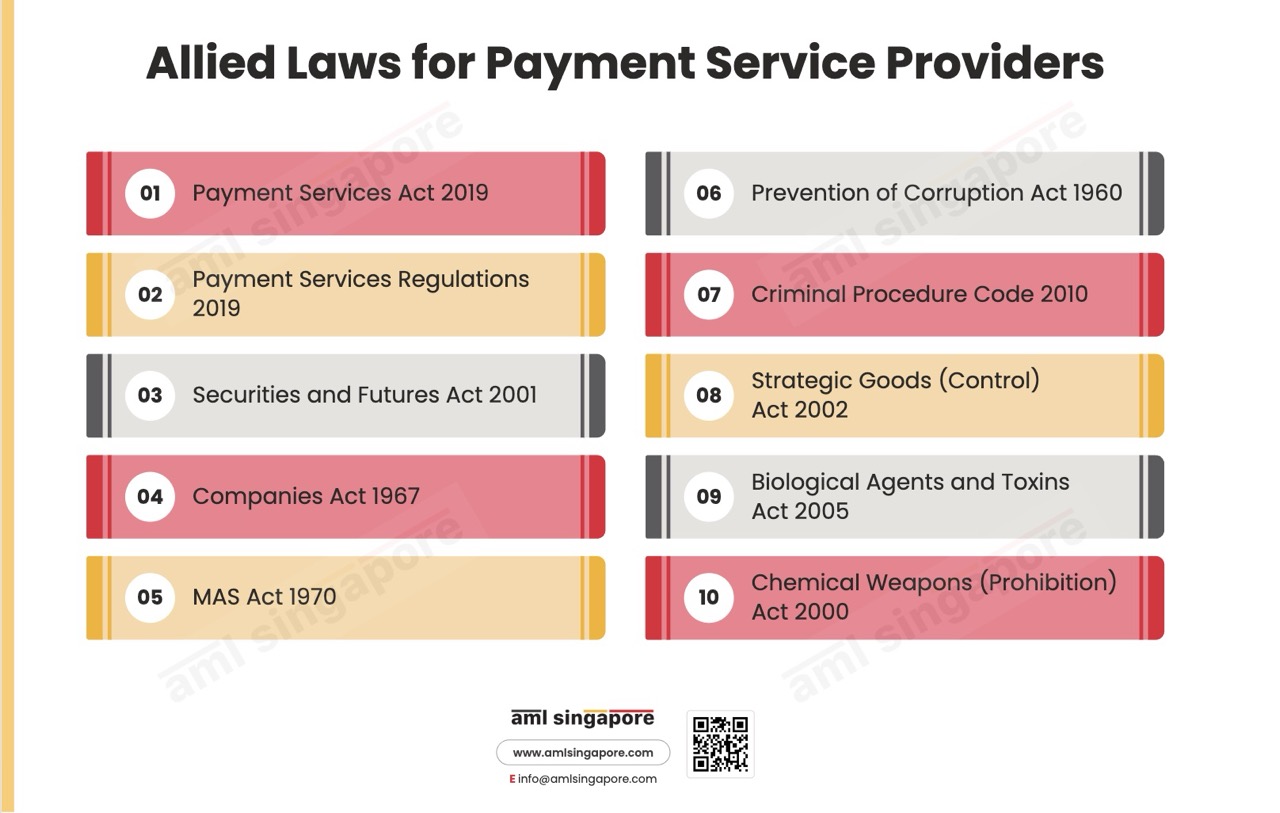
The Payment Services Act 2019
The principal statute governing Singapore’s payment services sector. It defines the regulated payment services and establishes the licensing framework for money changing service providers, standard payment institutions and major payment institutions. It provides the statutory foundation for MAS regulation of payment service providers, including the AML/CFT requirements imposed through Notice PSN01.
The Payment Services Regulations 2019
Subsidiary legislation made under the Payment Services Act 2019 that provides detailed requirements for licensing, financial and security requirements, safeguarding of customer money, digital payment token customer assets, audit and specified exemptions. It forms part of the wider regulatory framework applicable to payment service providers alongside the AML/CFT requirements in Notice PSN01.
The Securities and Futures Act 2001
The Securities and Futures Act 2001 becomes relevant where a payment service provider or its group also carries on regulated capital markets activities. Depending on the activity, this may require a capital markets services licence and subject the relevant entity to the AML/CFT requirements applicable to that regulated activity. It therefore marks an important boundary between the payment services and capital markets regulatory regimes.
The Companies Act 1967
Singapore’s general corporate law statute. Its register of registrable controllers requirements are relevant to AML/CFT because they require companies and other prescribed entities to maintain information on persons who ultimately own or control them and to lodge prescribed information with ACRA’s central register. For a payment service provider, this corporate information can support, but does not replace, its own customer due diligence and beneficial ownership verification obligations.
The Monetary Authority of Singapore Act 1970
The statute establishing the Monetary Authority of Singapore and setting out its principal objects and functions. MAS’s functions include overseeing payment systems and conducting integrated supervision of the financial services sector. It therefore provides the institutional and supervisory foundation for MAS’s regulation of payment service providers, while the Payment Services Act 2019 provides the sector specific statutory framework.
The Prevention of Corruption Act 1960
Singapore’s principal anti corruption statute. Corruption offences can constitute predicate offences for money laundering, making corruption proceeds relevant to a payment service provider’s transaction monitoring, suspicious transaction assessment and source of funds or wealth enquiries. Section 24 also provides an evidential mechanism concerning pecuniary resources or property disproportionate to an accused person’s known income, although this operates in corruption proceedings rather than as a standalone AML customer due diligence requirement.
The Criminal Procedure Code 2010
The principal legislation governing criminal investigations in Singapore. It provides law enforcement authorities with investigative powers, including powers relating to arrest, search, seizure and the obtaining or production of evidence. For a payment service provider, these powers can require the production or preservation of information and assets connected with a criminal investigation. Any discussion of tipping off should, however, be grounded in the applicable AML legislation rather than attributed generally to the CPC.
The Strategic Goods (Control) Act 2002
Regulates the transfer and brokering of strategic goods and strategic goods technology, including goods and technology capable of contributing to weapons of mass destruction and missile programmes. It is relevant to the proliferation financing framework because transactions involving controlled goods or technology can present PF risks.
The Biological Agents and Toxins Act 2005
Regulates the possession, use, importation, transhipment, transfer and transportation of specified biological agents and toxins, including prohibiting their use for non peaceful purposes. It forms part of Singapore’s legal framework for preventing the misuse of biological materials and is relevant to proliferation financing risk where financial activity is connected to prohibited biological weapons activities.
The Chemical Weapons (Prohibition) Act 2000
Implements Singapore’s obligations under the Chemical Weapons Convention by prohibiting activities involving chemical weapons, including their use, development, production, acquisition, stockpiling, retention and transfer. It is relevant to proliferation financing risk because financial transactions can potentially facilitate prohibited chemical weapons activities.
We draft AML/CFT policies, procedures and controls tailored to your payment services.
Miscellaneous Laws and Regulations Applicable to Payment Service Providers in Singapore
These national strategies, committee reports and typologies set the direction of Singapore’s regime and the public private partnership a provider operates within. They carry no binding force, but they direct how MAS supervises and supply many of the typologies a provider builds into its screening.
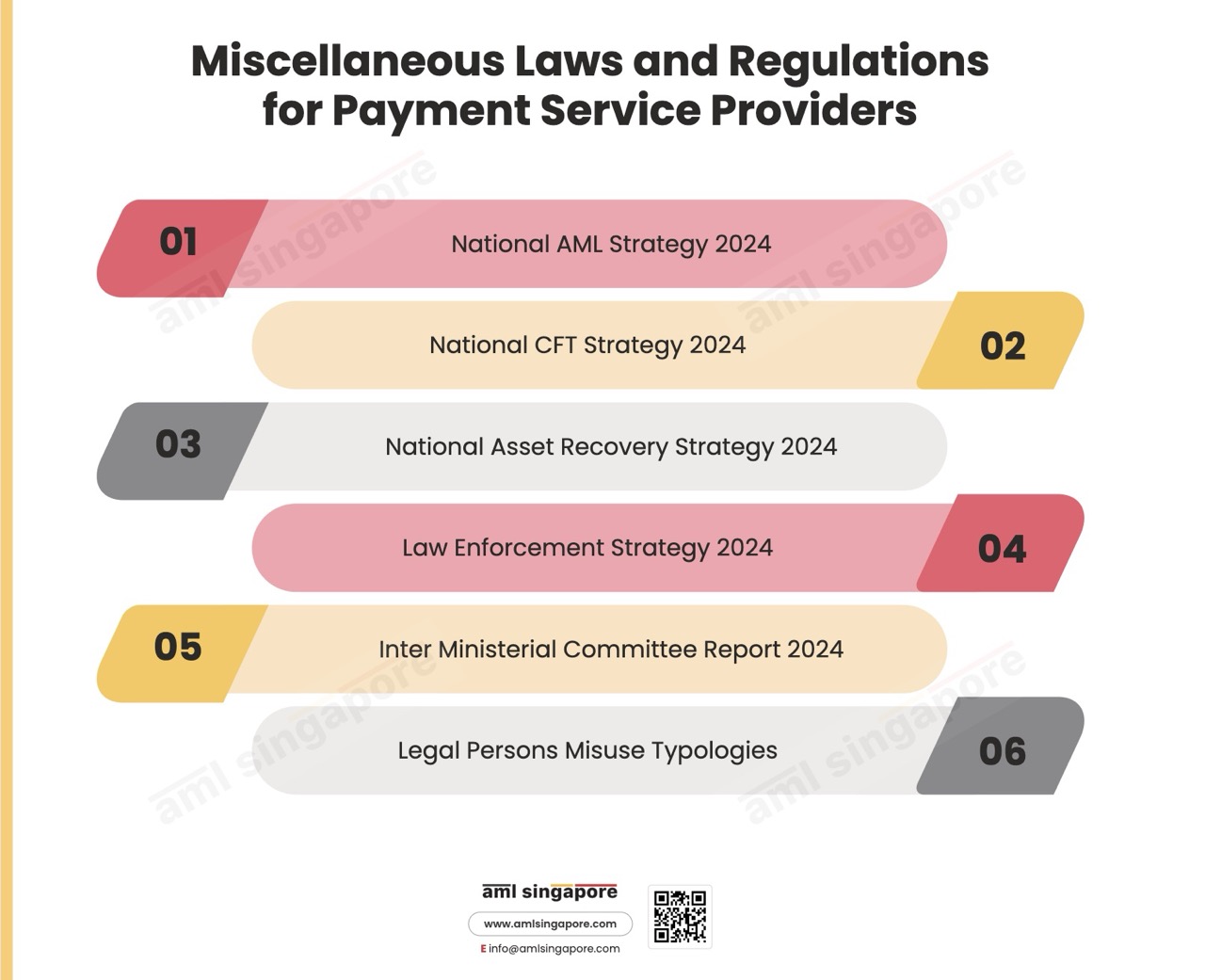
National Anti Money Laundering Strategy 2024
Singapore’s national AML blueprint, built on the pillars of Prevent, Detect and Enforce. A payment service provider sits within the Prevent pillar, where MAS commits to risk based supervision of financial institutions, including the payments sector, and to the beneficial ownership transparency a provider relies on for due diligence.
National Strategy for Countering the Financing of Terrorism 2024
Refreshed in 2024 alongside the terrorism financing risk assessment that flagged remittance and fast payment systems, this five pronged strategy spans coordinated risk identification, strong legal and sanctions frameworks, a robust regulatory regime, decisive enforcement and international partnership. It points the way a payments firm’s terrorism financing controls are expected to move.
National Asset Recovery Strategy 2024
Singapore’s plan to detect, deprive and deliver on the proceeds of crime, citing billions recovered in recent years. A payments firm is a working partner in it, because account balances and transfers still in flight can be caught by production orders and restraint, and prompt cooperation is expected.
Singapore Law Enforcement Strategy to Combat Money Laundering (October 2024)
A joint strategy from Singapore’s money laundering investigation agencies, laying out focus areas and key actions and relying on two way information flows with financial institutions. It describes the enforcement backdrop a payments firm feeds through its reports and its handling of production orders.
Inter Ministerial Committee on Anti Money Laundering Report (October 2024)
The post mortem review after a large money laundering case, with recommendations on curbing the misuse of corporate structures, the duties of gatekeepers and better information sharing. Its findings speak to a payments firm whose corporate customers may be shells used to route transfers, and they mark the firmer supervisory stance the sector now sits under.
Legal Persons: Misuse Typologies and Best Practices (2018)
A typologies and best practices paper examining how companies and other legal persons can be misused for money laundering and other illicit purposes. It identifies risk factors and misuse typologies relevant to beneficial ownership, corporate structures and the use of legal persons for banking and financial transactions. It is particularly useful for payment service providers onboarding corporate customers and assessing shell companies and other legal vehicles.
International Standards Applicable to Payment Service Providers in Singapore
Singapore’s AML/CFT/CPF framework is designed around the FATF standards, which provide the international benchmark for national AML/CFT/CPF regimes. FATF Recommendations, interpretive guidance, typologies and thematic reports therefore provide useful context for understanding the requirements imposed on payment service providers under Singapore’s domestic framework, including customer due diligence, beneficial ownership, wire transfers and proliferation financing controls.
The FATF Recommendations (updated June 2026)
The 40 FATF Recommendations, last updated in June 2026, provide the international standards for combating money laundering, terrorist financing and proliferation financing. Recommendation 16 establishes the international payment transparency standard reflected in Singapore’s wire transfer requirements. FATF also revised Recommendation 16 in June 2025, with implementation of the revised standard expected by the end of 2030
Methodology for Assessing Technical Compliance and Effectiveness (updated June 2026)
The FATF assessment methodology, used by evaluators to score a country’s technical compliance with the Recommendations and the effectiveness of its system. It explains the yardstick against which Singapore, and by extension its payment service providers, are measured, and it informs MAS’s supervisory expectations.
Mutual Evaluation Report of Singapore (May 2026)
The 2026 evaluation by the FATF and the Asia/Pacific Group gauges how well Singapore’s regime performs in practice. It frames supervisory expectations across the financial sector, including how Singapore licenses and supervises its payment institutions and money remittance sector for money laundering risk.
FATF Guidance on Politically Exposed Persons (Recommendations 12 and 22, 2013)
Sets out how a firm should spot politically exposed persons and apply enhanced due diligence to them: sign off from senior management, establishing the source of wealth and funds, and closer ongoing monitoring.
Guidance on Beneficial Ownership of Legal Persons (March 2023)
Guidance issued under the revised Recommendation 24 on how to obtain and verify beneficial ownership information, shaping how a firm pins down the beneficial owners of corporate customers and tells legal ownership apart from beneficial ownership.
Best Practices on Beneficial Ownership for Legal Persons (October 2019)
A collection of country best practices for keeping beneficial ownership information adequate, accurate and up to date, backing a firm’s reliance on registries and multiple sources when it onboards corporate customers and traces their controllers.
Concealment of Beneficial Ownership (July 2018)
A joint FATF and Egmont Group typologies report on how criminals hide beneficial ownership through intermediaries and structures, giving a provider the red flags to detect concealment behind a corporate sender or beneficiary of a transfer.
Risk Based Approach: Beneficial Ownership and Transparency of Legal Arrangements (March 2024)
Guidance focused on Recommendation 25 and trusts and similar arrangements, helping a provider assess and mitigate risk when a trust or legal arrangement is the customer or the counterparty to a transfer.
FATF Guidance on Counter Proliferation Financing (February 2018)
Guidance on implementing the financial provisions of Security Council resolutions against weapons of mass destruction proliferation, requiring a provider to screen and freeze without delay under Recommendation 7, which is acute where transfers can be routed to evade sanctions.
Guidance on Proliferation Financing Risk Assessment and Mitigation (June 2021)
Sets out how a provider assesses and mitigates proliferation financing risk following the amended Recommendations 1 and 2, which extended risk assessment duties to proliferation financing across the financial sector.
Guidance on Digital Identity (March 2020)
Helps a provider decide whether a digital identity system is reliable and independent enough for customer due diligence under a risk based approach, which is central to the remote onboarding that e wallet and remittance apps rely on.
Trade Based Money Laundering
A concise handout on trade based money laundering techniques, relevant to a payment service provider whose customers make payments for goods, since over and under invoicing and phantom shipments can move value through payment and remittance flows.
Money Laundering from Environmental Crime (July 2021)
A typologies report on laundering the proceeds of environmental crime, flagging the red flags a provider may see in cross border transfers linked to commodity, resource and forestry trade.
Artificial Intelligence and Deepfakes: Impacts on ML/TF/PF
A forward looking FATF scan of how artificial intelligence and deepfakes threaten preventive systems, for example synthetic identities and deepfake selfies defeating the remote onboarding a payments business depends on, alongside AI’s uses in monitoring.
Targeted Update on Stablecoins and Unhosted Wallets, Peer-to-Peer Transactions (March 2026)
A FATF paper on the risks of stablecoins, unhosted wallets and peer to peer transfers. It is relevant at the edge of the payments sector, where a provider’s rails connect to token activity, and it informs the attention given to transfers linked to digital payment tokens.
Summary of Key Instruments
The table below distils the instruments a payment service provider relies on most, what type each is, whom it binds, and the core obligation it places on a provider. Treat it as a quick reference, not a stand in for the fuller sections above.
|
Instrument |
Type |
Who it binds |
Core obligation for a provider |
|
CDSA 1992 |
Statute |
All persons and providers |
Report suspicions (STR), do not tip off, keep records |
|
Terrorism (Suppression of Financing) Act 2002 |
Statute |
All persons and providers |
Freeze terrorist property; inform the authorities |
|
FSM Sanctions Regulations (DPRK, Iran) 2023 |
Regulations |
Persons and entities within the scope of the respective sanctions regimes |
Freeze designated persons’ assets; report to MAS |
|
MAS Notice PS N01 |
Notice (PS Act) |
Payment service providers within the scope of the Notice |
Risk based CDD, EDD, wire transfer rule, STR, records |
|
Guidelines to PS N01 |
Guidelines |
PSPs within the scope of PSN01 |
How to meet the Notice; observance affects MAS assessment |
|
Payment Services Act 2019 |
Statute |
Payment service providers and other persons within its scope |
Licensing of the specified payment services |
|
MAS Act 1970 |
Statute |
MAS and persons within its regulatory framework |
Source of MAS supervisory authority |
|
ML, TF and PF NRAs 2024 |
Risk assessments |
Whole system |
Feed the provider’s enterprise wide risk assessment |
|
FATF Recommendations |
International standard |
Global baseline |
Underpin the domestic rules, including the wire transfer rule |
Conclusion
For a payment service provider in Singapore, the anti money laundering framework is detailed but coherent. The criminal statutes make laundering and terrorism financing offences and require suspicions to be reported; the sanctions regulations require assets to be frozen; and Notice PS N01 with its Guidelines turns all of this into a working system of risk based customer due diligence, enhanced due diligence for higher risk relationships, the wire transfer travel rule, ongoing monitoring and suspicious transaction reporting. Because the sector takes in cash and sends value across borders, a provider’s controls have to be built around fast, high volume transfers and the agents and channels that carry them.
The instruments interlock. A provider’s enterprise wide risk assessment draws on the national risk assessments; its due diligence, wire transfer and beneficial ownership work flows from Notice PS N01 and its Guidelines; its licensing and conduct obligations come from the Payment Services Act and its regulations; and its sanctions and proliferation controls draw on the FSM Act sanctions regulations and the FATF standards. Seeing how the pieces connect is what turns a set of controls that merely exist into a framework a firm can defend.
Frequently Asked Questions
MAS Notice PS N01 is the anti money laundering and countering the financing of terrorism notice for holders of a payment services licence that carry on a specified payment service, and for certain exempt persons. It is read together with the Guidelines to Notice PS N01. The digital payment token service is covered by a separate notice, PS N02.
Notice PSN01 covers specified payment services within its scope, including account issuance, domestic money transfer, cross border money transfer, merchant acquisition, e money issuance and money changing. Digital payment token services are regulated separately under Notice PSN02.
CDD is required when a provider establishes business relations, carries out specified occasional transactions above S$5,000 for a customer without an established business relationship, carries out specified cross border transfers for such a customer, suspects money laundering or terrorism financing, or has doubts about previously obtained customer information. Transactions that appear deliberately structured to avoid a threshold should be aggregated.
For cross border wire transfers, the ordering institution must ensure that the required originator and beneficiary information accompanies the transfer. Transfers of S$1,500 or less are subject to reduced information requirements, while transfers above S$1,500 require additional originator information, including specified identification details.
Yes. Money changing is a specified payment service within the scope of Notice PSN01. Licensed money changers must apply the applicable risk based AML/CFT controls, including CDD and suspicious transaction reporting, and should address risks such as structuring and unusual cash activity.
A provider must file an STR where it has reasonable grounds to suspect money laundering or terrorism financing. The report should be submitted to STRO without delay. The PSN01 Guidelines state that the internal process for determining whether a matter should be referred to STRO should not exceed 15 business days after referral by the relevant employee or officer, except in exceptional or extraordinary circumstances.
Yes. Where a provider operates through agents, the licensed principal remains responsible for the AML/CFT controls carried out through those agents. It must therefore maintain appropriate oversight, due diligence, training and monitoring of its agents.
About the Author

Pathik Shah
FCA, CAMS, CISA, CS, DISA (ICAI), FAFP (ICAI)
Pathik is a Chartered Accountant with more than 26 years of experience in governance, risk, and compliance. He helps companies with end-to-end AML compliance services, from conducting Enterprise- Wide Risk Assessments to implementing the robust AML Compliance framework. He has played a pivotal role as a functional expert in developing and implementing RegTech solutions for streamlined compliance.