AML Laws and Regulations for Precious Stones and Precious Metals Dealers in Singapore
In a Nutshell
A dealer in precious stones and precious metals is exposed to AML risk because it can convert large amounts of money into compact, portable and high-value assets such as gold, gems and jewellery, making the trade attractive for money laundering.
Dealers are supervised by the registrar of regulated dealers in the Ministry of Law’s AML, CFT and CPF division.
The core framework is the Precious Stones and Precious Metals (Prevention of Money Laundering, Terrorism Financing and Proliferation Financing) Act 2019 and its regulations, which require dealers to register, conduct customer due diligence for cash transactions or digital payment tokens of SGD 20,000 or more and submit cash transaction reports within 15 business days. The Registrar’s Guidelines for Regulated Dealers, together with its compliance toolkit and red flag indicators, provide practical guidance in applying these obligations.
Singapore’s 2024 national risk assessment identifies the sector as facing a moderately high money laundering threat, reflecting its high-value and portable products, the potential for anonymity, and its exposure to walk-in, one-off and foreign customers. Cash transactions, digital tokens and barter arrangements can further increase the risk.
The wider framework also includes Singapore’s criminal and sanctions laws, national risk assessments, corporate legislation and the FATF recommendations, which together provide the broader AML, CFT and CPF obligations applicable to the trade.
AML Laws and Regulations for Precious Stones and Precious Metals Dealers in Singapore
A dealer in gold, gems and jewellery deals in value that is easy to carry and hard to trace, and that is why the trade sits under a full anti-money laundering regime. This guide sets out the laws and regulations that apply to a regulated dealer in Singapore, from the criminal statutes that make money laundering an offence to the specific rulebook the Registrar of Regulated Dealers enforces on the precious stones and precious metals trade.
The framework is best understood in layers. At the base are Singapore’s criminal and targeted financial sanctions laws. Above these sits the rulebook a dealer applies in its day-to-day business: the Precious Stones and Precious Metals Act 2019, its Regulations and the Registrar’s Guidelines for Regulated Dealers. Alongside these are Singapore’s national risk assessments, the corporate laws governing the businesses that operate in the sector, and the FATF standards that underpin the wider AML, CFT and CPF framework.
A dealer’s risk is closely tied to the nature of the trade: it can take in cash and convert it into gold, precious stones or jewellery that represents a compact store of value. This creates a classic placement risk, where illicit cash is converted into an asset that can be held, resold or moved across borders. That risk explains many of the obligations that follow, from cash transaction reporting based on the transaction value alone to customer due diligence before a large sale and closer scrutiny of one-off walk-in buyers.
Singapore's precious stones and precious metals sector at a glance
Approximately 1,900 dealers were registered as regulated dealers in Singapore at the end of 2023, ranging across the retail and wholesale trade in precious stones, precious metals and precious products (Money Laundering National Risk Assessment 2024, chapter 8.5).
Dealers must file a cash transaction report with the Suspicious Transaction Reporting Office within 15 business days for any cash transaction exceeding S$20,000; failure to do so can lead to prosecution and fines (ML NRA 2024, chapter 8.5, Case Study 41).
Risk rating: the sector is assessed as exposed to a moderately high money laundering threat and more vulnerable than most, driven by the high intrinsic value, portability and anonymity of the goods (ML NRA 2024, chapter 8.5).
Core AML Laws and Regulations for Precious Stones and Precious Metals in Singapore
These statutes and sanctions regulations make money laundering, terrorism financing and proliferation financing offences and require every regulated dealer to detect and report them. They bind dealers directly, whatever the trade’s own rules say, and the Precious Stones and Precious Metals Act is built to align with them.
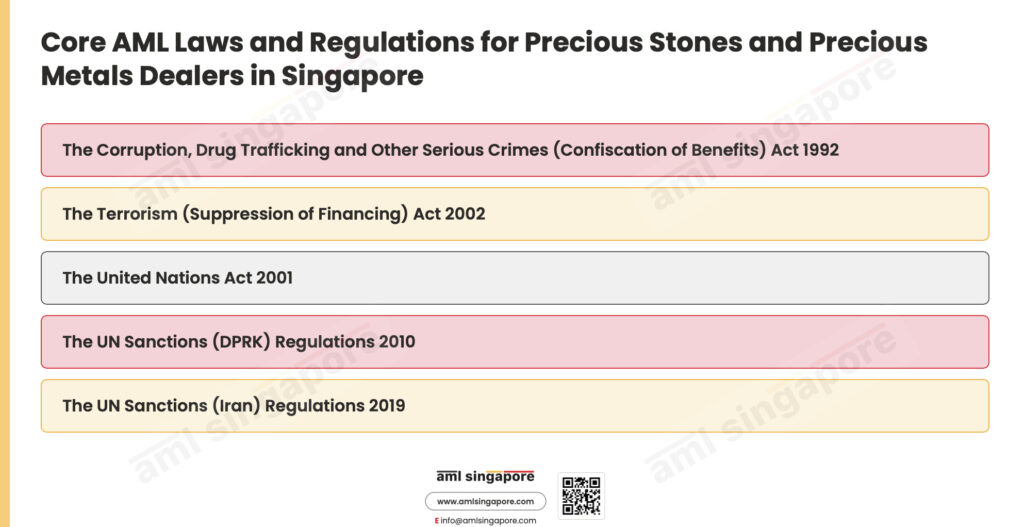
The Corruption, Drug Trafficking and Other Serious Crimes (Confiscation of Benefits) Act 1992
The CDSA carries Singapore’s money laundering offences and allows the courts to confiscate criminal proceeds. Dealers have also been convicted under it, including for selling gold and jewellery for criminal cash and failing to file the required reports. Dealers must report suspicious transactions to the Suspicious Transaction Reporting Office where they know or have reasonable grounds to suspect that a transaction involves criminal proceeds and must not tip off the customer. Cash transaction reports are a separate threshold based reporting requirement under the sector-specific PSPM Act.
The Terrorism (Suppression of Financing) Act 2002
Under the TSOFA, it is a crime to raise, supply or handle property meant for terrorism, or to deal with property terrorists own or control. Dealers must not sell to, or buy from, a person it knows or reasonably believes to be a terrorist entity, and it must tell the authorities; the duty is discharged mainly by checking the customer and any beneficial owner against the terrorism lists.
The United Nations Act 2001
The Act empowers the Minister to give United Nations Security Council sanctions binding domestic effect, and it is the basis for Singapore’s measures. Dealers rely on the sanctions regulations issued under it, not on the Act itself, testing its customers against the designated person lists those regulations set out.
The United Nations (Sanctions, Democratic People's Republic of Korea) Regulations 2010
Made under the United Nations Act, these regulations bring the Security Council’s North Korea sanctions into domestic force and bind dealers directly. Dealers must not sell precious stones or metals to, or buy them from, a designated person, and must freeze and report a match rather than complete the sale, whatever the customer’s apparent standing.
The United Nations (Sanctions, Iran) Regulations 2019
The Iran regulations carry the Security Council’s Iran measures into Singapore law and reach dealers in the same way. Dealers screen their customers and any beneficial owners against these lists before a designated transaction and escalate any hit rather than clearing it quietly so the sale can proceed.
Overarching AML Laws and Regulations Applicable to Precious Stones and Precious Metals Dealers in Singapore
These instruments cut across the whole regime and give a dealer the practical means to discharge its reporting duties, both the cash transaction report and the suspicious transaction report, and to recognise terrorism financing at the point of sale.
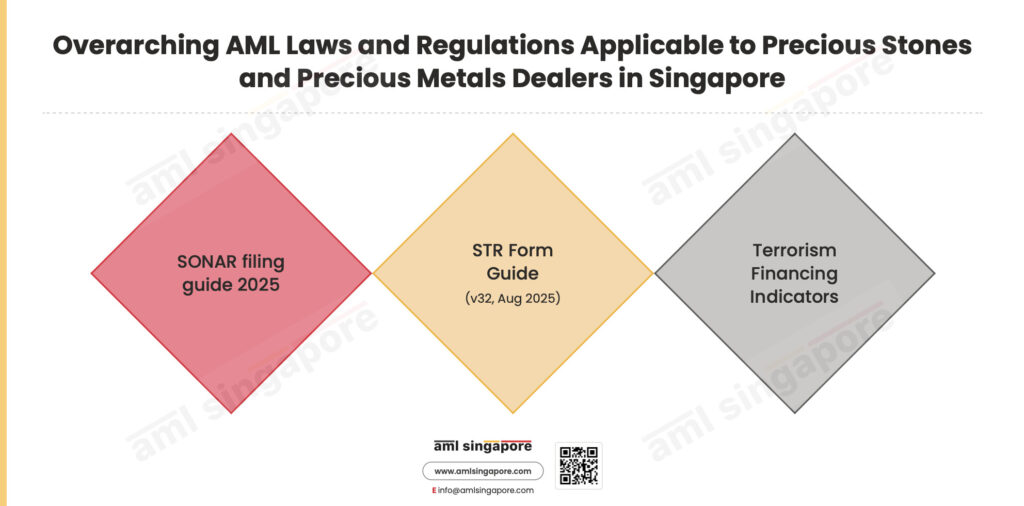
Getting Started with SONAR, for STR Filers (2025)
SONAR is the STRO Online Notices and Reporting platform through which dealers lodge their suspicious transaction reports and their cash transaction reports electronically. It provides registration, user role assignment and submission, and serves as the channel through which reporting duties are fulfilled. A dealer’s compliance staff use it to report on time and maintain proof of every filing.
Form Guide for the STR Form (Version 12 August 2025)
A walkthrough of the current suspicious transaction report form, explaining what each field requires, from the reporting dealer’s particulars to the grounds for suspicion, and requiring a distinct internal reference for every filing. A dealer’s staff reach for it when they need to report a questionable sale or a buyer whose money will not reconcile.
Terrorism Financing Indicators
A STRO reference that categorises terrorism financing indicators into due diligence red flags, out-of-pattern fund movements and transactions lacking economic rationale. It sharpens a dealer’s ability to identify terrorism financing risks behind a high-value purchase and supports the filing of a terrorism financing report.
National Risk Assessments Applicable to Precious Stones and Precious Metals Dealers in Singapore
Singapore publishes formal assessments of where its money laundering, terrorism financing and proliferation financing risks lie, and dealers are expected to weigh their findings in their own risk assessment. For this trade, the message is pointed: precious stones and metals are a favoured store of value for illicit cash, which places the sector among the more vulnerable.
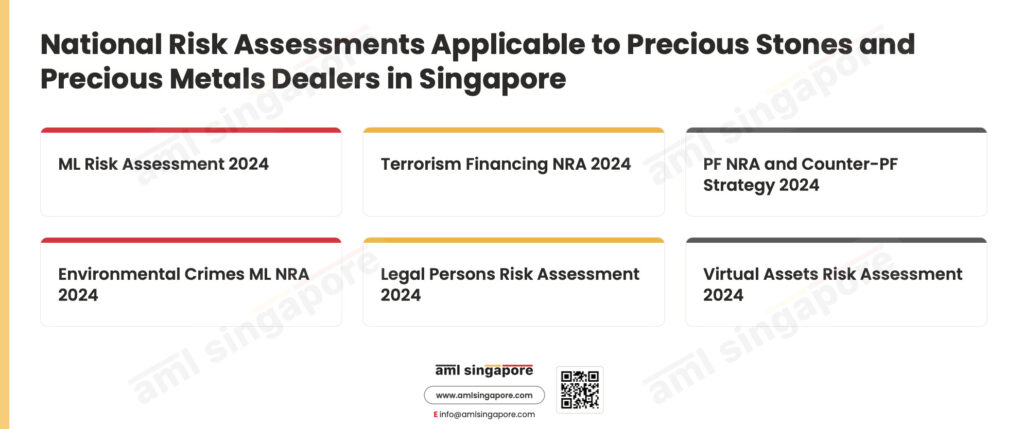
Money Laundering National Risk Assessment Singapore 2024
The national money laundering assessment gives the trade a section of its own and rates the threat as moderately high, with the sector more vulnerable than most. It records that illicit cash is typically converted into precious stones and metals as an appreciating store of value, that ownership is anonymous, and that retail, walk-in and one-off customers, including tourists, add risk. Dealers should read these findings into their sector risk assessment.
Terrorism Financing National Risk Assessment 2024
The terrorism financing assessment concentrates on banks, remittance and cross-border channels rather than on dealers, and the direct terrorism financing threat at the counter is low. The dealers still apply the assessment’s typologies when it screens a customer and review a high-value purchase that could serve a terrorism financing purpose.
Proliferation Financing National Risk Assessment and Counter PF Strategy 2024
This assessment identifies sanctions evasion, the misuse of legal persons and dual-use trade as the principal proliferation routes. The dealer’s exposure is distant, coming chiefly through the sanctions link, which is why checking its customers against the designations carries the counter proliferation weight for the trade.
Environmental Crimes Money Laundering National Risk Assessment (May 2024)
A study of how the proceeds of environmental crime are laundered, including through the trade in gold, which can be mined illegally and sold on. It rates banks and remittance agents as the high-risk sectors, but it is squarely relevant to metal dealers, for whom the provenance of gold can carry an environmental crime taint.
Money Laundering and Terrorism Financing Risk Assessment of Legal Persons (2024)
This assessment places companies in a higher residual money laundering risk band. It bears on dealers where a corporate customer buys high-value stock, since the dealers must see through the company to the natural person behind the purchase, particularly in a wholesale deal.
Virtual Assets (Digital Payment Tokens) Risk Assessment (2024)
This assessment weighs Singapore’s exposure to digital payment token activity. It is squarely relevant to dealers, because a customer may settle for stones or metals in digital payment tokens or seek to redeem an asset backed token, a payment channel the national assessment marks as raising the risk.
Precious stones and metals dealer ML/TF risk snapshot
Money laundering: moderately high threat and a sector assessed as more vulnerable than most, because the goods are a compact, anonymous, appreciating store of value (ML NRA 2024, chapter 8.5).
Main features to watch: large cash payments, one-off and walk-in buyers including tourists, payment in digital payment tokens, and bartering gold for jewellery (ML NRA 2024, chapter 8.5).
Terrorism and proliferation financing: low and remote, addressed through screening the customer against the sanctions and terrorism designations (TF NRA 2024; PF NRA 2024).
Controls: the Registrar of Regulated Dealers registers and supervises the trade, and a dealer must perform due diligence and file a cash transaction report on a cash transaction of S$20,000 or more (ML NRA 2024, chapter 8.5).
Sector-Specific Guidance Applicable to Precious Stones and Precious Metals Dealers in Singapore
This is the core of dealers’ obligations. The trade is supervised by the Registrar of Regulated Dealers, the Precious Stones and Precious Metals Act and its Regulations, supported by the Registrar’s Guidelines. The two core instruments, the Act with its Regulations and the Guidelines, are covered in full below.
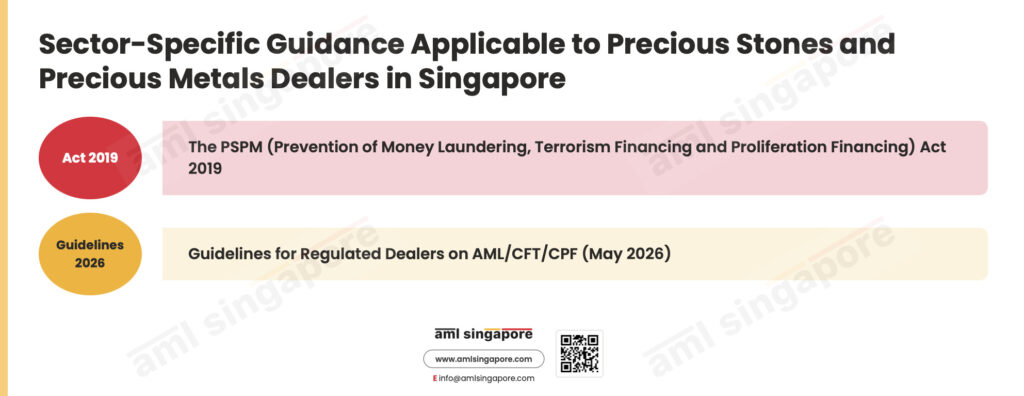
The Precious Stones and Precious Metals (Prevention of Money Laundering, Terrorism Financing and Proliferation Financing) Act 2019
The Precious Stones and Precious Metals Act 2019, with its Regulations, is the binding AML, CFT and CPF rulebook for the trade, and it subjects dealers to a full regulatory and supervisory regime. It is built around the regulated dealer, defined as a person who carries on regulated dealing, which covers manufacturing, importing or possessing for sale, selling, and purchasing for resale any precious stone, precious metal or precious product, and the selling or redeeming of asset backed tokens. The Act is administered by the Registrar of Regulated Dealers within the Ministry of Law’s AML/CFT Division, and it turns on two ideas: registration of the dealer, and duties triggered by a designated transaction.
Registration comes first. A person must not act as, or hold out to be, a regulated dealer unless registered with the Registrar, so entry to the trade is itself a control, screening those who would deal in high-value goods. Once registered, a dealer must run an anti-money laundering programme: it must assess and document its risks across its customers, products and channels, put in place internal policies, procedures and controls, appoint a compliance officer, train its staff, and keep the programme under review, all scaled to the size and risk of the business.
The heart of the regime is the customer due diligence tied to a designated transaction. A designated transaction includes a cash transaction at or above the threshold amount of SGD 20,000, and before entering into one, a dealer must perform the prescribed due diligence: obtain and verify the customer’s identifying information from reliable and independent sources, identify any person on whose behalf the customer acts and the beneficial owner, and screen them against the sanctions and terrorism designations. Due diligence is also required where the dealer suspects money laundering or terrorism financing, whatever the amount, or doubts information it already holds. Simplified measures are available only where the risk is low, and enhanced due diligence is required for high-risk customers and transactions, including a politically exposed person, calling for steps to establish the source of wealth and funds.
The reporting duties are distinctive because there are two. A dealer must file a cash transaction report with the Suspicious Transaction Reporting Office within fifteen business days for any cash transaction exceeding SGD 20,000, a duty that turns on the size of the cash payment rather than on suspicion, and the failure to file such reports has led to the prosecution and fining of dealers. Separately, a dealer must file a suspicious transaction report whenever it has reasonable grounds to suspect money laundering or terrorism financing, and it must not tip off the customer. The two reports run in parallel and are not interchangeable.
The Regulations are precise about the identifying information a dealer must capture and hold. For an individual customer, that means the full name and any alias, a residential address, a date of birth and nationality, and an identification number drawn from an approved identifying document such as an identity card or passport, with the type of document recorded; for a corporate customer, it extends to the entity’s particulars and the beneficial owner behind it. A dealer must verify that information against reliable and independent sources, retain it, and keep the records of a designated transaction and the due diligence behind it so that a sale can later be reconstructed. Because the goods leave the shop but the record stays, that record is often the only lasting trace of who acquired a compact, anonymous store of value, which is why the Regulations treat record-keeping as central rather than incidental.
The Regulations fill in the detail, and the Act completes the frame. The Regulations set out the identifying information a dealer must collect, the enhanced and simplified due diligence measures, the keeping of records, and the risk assessment, internal controls and procedures a dealer must maintain. The Act backs all of this with the Registrar’s powers of registration, inspection and enforcement, and with offences and penalties for a dealer that fails to register, to perform due diligence, or to file the reports the regime requires. Read together, the Act and its Regulations turn the sale of a compact, high-value good into a monitored, recorded and reportable transaction.
Guidelines for Regulated Dealers on AML/CFT/CPF (May 2026)
The Guidelines for Regulated Dealers issued by the Registrar, most recently in 2026, are the primary guidance a dealer works with alongside the Act, and they are given the fullest treatment here. They translate the statutory duties into practical steps for a trade that ranges from a single retail shop to a wholesale house, and although they are guidance rather than a binding instrument, they are how the Registrar expects dealers to read and apply the Act, so in practice they are the working manual for the sector.
The Guidelines begin with the sector’s risk picture and the risk-based approach. They explain why precious stones and metals attract laundering, that the goods are compact and hold value, that ownership is anonymous, and that the retail trade sees walk-in and one-off customers, and they walk a dealer through assessing its own risk across its customers, its products and its channels. They stress that the depth of due diligence should follow the risk, so that an occasional high-value walk-in buyer or a customer paying in cash or digital tokens draws closer attention than a long standing account.
On customer due diligence, the Guidelines work through the measures in practical detail: how to obtain and verify a customer’s identifying information, when the SGD 20,000 threshold brings a designated transaction into play, how to identify a person acting for another and the beneficial owner behind a corporate buyer, and when simplified or enhanced measures apply. They give particular attention to establishing source of wealth and funds where a purchase is large, or the payment method obscures the trail, and to the extra care a one-off or foreign customer demands.
The Guidelines are at their most useful on the two reports and the everyday signals. They explain when a cash transaction report must be filed and within what time, how a suspicion becomes a suspicious transaction report to the Suspicious Transaction Reporting Office without tipping off the customer, and how the two duties differ. They are reinforced by a compliance toolkit, a set of red flag indicators for regulated dealers, and additional guidance on assessing customer risk, spotting material red flags, establishing source of wealth and monitoring customers and their transactions, as well as a code of practice aimed at scam related laundering, so that a dealer has a full set of practical tools.
The Guidelines also help a dealer size its programme to its business. They recognise that the trade runs from a single jeweller with a shopfront to a wholesale house moving bullion, and they make clear that the depth of policies, controls and monitoring should be proportionate to that scale and to the risk a dealer actually faces, rather than a uniform template imposed on all. For a small retailer this means a lean but genuine set of controls built around the counter and the SGD 20,000 threshold; for a larger or wholesale dealer it means a fuller programme, a named compliance officer, and closer monitoring of high-value and cross-border business. In either case, the Guidelines press the point that controls must be used and evidenced, not merely written, since the Registrar inspects against what a dealer actually does rather than what its manual claims. In practice, that means a dealer should be able to show completed due diligence records, filed reports and a live risk assessment, not just a policy on a shelf, because it is the day-to-day evidence, not the document, that a supervisor tests when it visits a shop or calls for a file.
The Guidelines are candid about the consequences and the direction of travel. They set out the offences a dealer and its officers can commit and the penalties that follow, drawing on real cases where dealers were fined for failing to file cash transaction reports or to perform due diligence, so that the trade understands the regime is enforced. They also reflect the Registrar’s growing focus on emerging risks, from payment in digital payment tokens to scam related money laundering, and they make clear that a dealer must keep its controls current as those risks evolve. Read with the Act and its Regulations, the Guidelines turn a set of statutory duties into a routine a dealer can run at the counter and in the back office.
The reporting and due diligence triggers a dealer applies
The regime turns on clear triggers, most of them tied to the S$20,000 cash threshold. Each trigger, and the step it obliges under the Act, is set out in the table that follows.
Trigger | What the regulated dealer must do under the PSPM Act 2019 |
A cash transaction of S$20,000 or more | A designated transaction: perform customer due diligence before entering into it (section 16) |
That same cash transaction, once done | File a cash transaction report with STRO within 15 business days (section 17) |
Any suspicion of ML, TF or PF | Perform due diligence whatever the amount, and file a suspicious transaction report |
Doubt about information already held | Repeat or complete due diligence to resolve the doubt before proceeding |
A high-risk customer or transaction | Apply enhanced due diligence, including establishing source of wealth and funds (regulation 7) |
Acting as a dealer at all | Be registered with the Registrar of Regulated Dealers before carrying on regulated dealing (section 6) |
Why precious stones and metals attract laundering
The national assessment explains the trade’s vulnerability through the nature of the goods and the customers. The table below maps it to a dealer’s controls.
Why PSPMs attract laundering | What it means for a dealer’s controls |
High value in a compact form | A large sum can be placed in a small, portable item that holds or gains value, so a single sale can absorb substantial illicit funds |
Anonymity of ownership | Stones and metals carry no register of ownership, so the dealer’s due diligence is the main record of who acquired them |
Retail, walk-in and one-off buyers | Much of the retail trade is with customers seen once, including foreign tourists who may be from high-risk jurisdictions |
Large cash payments | Cash hides the source and ownership of funds, which is why a cash transaction at the threshold triggers due diligence and a report |
Digital tokens and bartering | Payment in digital payment tokens, or bartering gold for jewellery, obscures the trail and can raise the risk further |
Allied Laws Applicable to Precious Stones and Precious Metals Dealers in Singapore
These legislative instruments are not primarily AML instruments, but each supports the regime: some govern the legal persons behind a corporate buyer, while others give investigators their powers or create the offences dealers screen against.
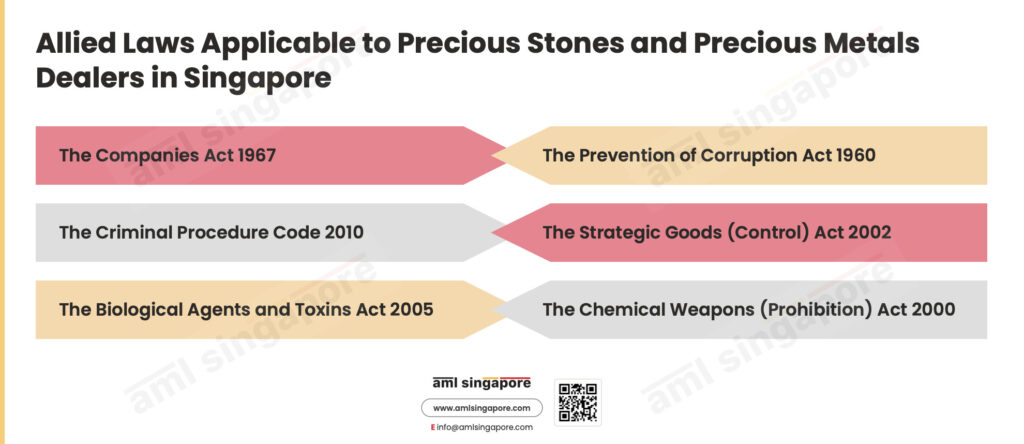
The Companies Act 1967
The principal statute governing companies, relevant to dealers where a corporate customer buys or sells high-value stock, for example, a wholesale buyer. Its beneficial ownership provisions support the dealer’s duty of looking through a corporate customer to the natural person behind the purchase.
The Prevention of Corruption Act 1960
Singapore’s principal anti-corruption law. Because corruption is a predicate offence for money laundering and its proceeds are among the funds dealers watch for when a customer pays for gold or gems in a way that does not fit their profile, and its presumption on unexplained assets reinforces scrutiny where the source of the money cannot be explained.
The Criminal Procedure Code 2010
The statute that lays down criminal procedure in Singapore, including the powers to demand production and to search and seize. When a production order reaches a dealer about a sale or a customer, the dealer has to surrender what is asked, preserve its records and tell the customer nothing, and in that way an investigation gains access to a dealer’s books and stock records.
The Strategic Goods (Control) Act 2002
It governs the transfer and brokering of strategic and dual-use goods; the proliferation financing nexus dealers meet at a distance, where a customer’s funds derive from a business that touches such trade, adding a strand to the source of funds enquiry on a high-risk buyer.
The Biological Agents and Toxins Act 2005
A Singapore weapons of mass destruction predicate statute that prohibits the hostile use, production or transfer of scheduled biological agents and toxins. For dealers, it figures only as one of the offences behind its proliferation screening, reached in the unlikely event a customer is tied to such activity.
The Chemical Weapons (Prohibition) Act 2000
Singapore’s law giving effect to the Chemical Weapons Convention. It criminalises the use, development, acquisition or transfer of chemical weapons and underpins the proliferation checks dealers perform when screening a customer, relevant only at the outermost edge of the trade’s risk.
Miscellaneous Laws and Regulations Applicable to Precious Stones and Precious Metals Dealers in Singapore
These national strategies, committee reports and typologies set the direction of Singapore’s regime dealers operate within. They carry no binding force, but they steer how supervisors act and supply typologies a dealer builds into its checks.
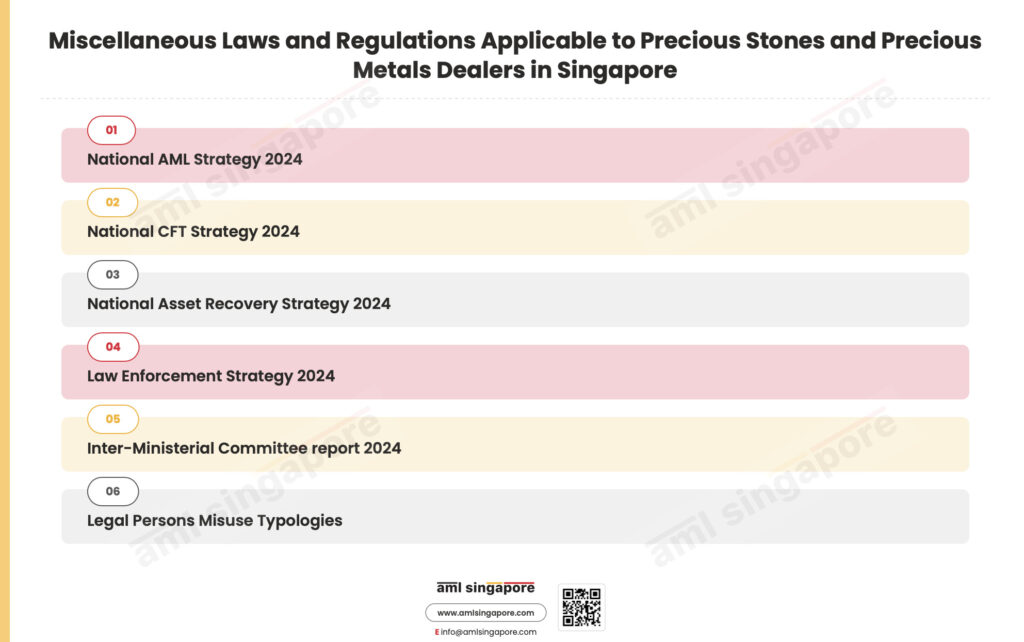
National Anti Money Laundering Strategy 2024
The national AML plan is at the highest level, set out across three pillars of Prevention, Detection and Enforcement. Dealers, as a high-value goods business, fall under Prevention, where the authorities run risk-based supervision and draw on the cash and suspicious transaction reports the dealers submit.
National Strategy for Countering the Financing of Terrorism 2024
Refreshed in 2024 with the terrorism financing risk assessment, this strategy advances along five lines at once, joining up how risk is identified, hardening the legal and sanctions framework, keeping supervision robust, pressing enforcement and deepening cross-border cooperation. It points dealers toward where their terrorism financing controls should go.
National Asset Recovery Strategy 2024
Singapore’s plan for tracing, seizing and returning the proceeds of crime, and precious stones and metals bought with illicit cash are exactly the kind of asset it targets. Dealers contribute through their reporting and cooperation with production orders, and their records help trace goods bought with criminal money.
Singapore Law Enforcement Strategy to Combat Money Laundering (October 2024)
A combined strategy of Singapore’s money laundering investigation agencies, setting priority areas and key actions and depending on information passing both ways with the private sector. It sets the enforcement scene that dealers reinforce through the reports they file on doubtful high-value sales.
Inter Ministerial Committee on Anti Money Laundering Report (October 2024)
Commissioned after a major laundering case, this review put forward recommendations on curbing the abuse of structures, tightening the responsibilities of gatekeepers and improving information sharing. It extends to high-value goods trade such as this and signals the sterner supervisory posture the wider sector now works under.
Legal Persons: Misuse Typologies and Best Practices (2018)
A typologies paper on how corporate vehicles and partnerships are turned to illicit ends. It assists dealers whose customer is a company buying high-value stock, offering indicators for tracing through to the individual truly behind the purchase.
International Standards Applicable to Precious Stones and Precious Metals Dealers in Singapore
Singapore’s regime is built to meet the FATF standards, and the Precious Stones and Precious Metals Act tracks them, including the standard that designates dealers in precious metals and stones as a business subject to AML obligations. These instruments are the least sector-specific of all, yet they are the source of the domestic rules and the typologies a dealer is expected to follow.
The FATF Recommendations (updated June 2026)
The 40 Recommendations are the global AML, CFT and CPF standard behind every obligation on a dealer, and Recommendations 22 and 23 name dealers in precious metals and precious stones as a designated business that must apply customer due diligence and report suspicions above a threshold, which is the origin of the domestic regime.
Mutual Evaluation Report of Singapore (May 2026)
The review by the FATF and the Asia/Pacific Group. It judges how effectively Singapore’s regime works in practice, including the supervision of dealers in precious metals and stones as a designated sector and frames the expectations the Registrar carries into its oversight.
Methodology for Assessing Technical Compliance and Effectiveness (updated June 2026)
The FATF’s instrument for gauging both technical compliance with the Recommendations and how effective a country’s defences prove in practice. It sets the standard by which Singapore, with its dealer trade, is measured, and it feeds into what the Registrar expects.
FATF Guidance on Politically Exposed Persons (Recommendations 12 and 22, 2013)
Sets out how to recognise a politically exposed person and raise the level of due diligence in response, senior management approval, verifying the source of wealth and funds, and closer monitoring, all of which a dealer brings to bear on a PEP buying high-value stones or metals.
Guidance on Beneficial Ownership of Legal Persons (March 2023)
Guidance under the revised Recommendation 24 on obtaining and verifying beneficial ownership information, shaping how a dealer identifies the natural person behind a corporate customer buying high-value stock.
Best Practices on Beneficial Ownership for Legal Persons (October 2019)
A collection of country best practices for keeping beneficial ownership information adequate, accurate and up to date, backing a dealer’s checks where a company stands behind a purchase.
Concealment of Beneficial Ownership (July 2018)
A FATF and Egmont Group typologies report on how criminals hide beneficial ownership through intermediaries and structures, giving a dealer the red flags where a buyer seems to be acting for someone hidden.
Risk Based Approach: Beneficial Ownership and Transparency of Legal Arrangements (March 2024)
Guidance under Recommendation 25 on trusts and similar arrangements, of narrow but real use to a dealer where a trust or similar structure stands behind a high-value purchase.
FATF Guidance on Counter Proliferation Financing (February 2018)
Guidance on carrying out the financial provisions of Security Council resolutions against weapons of mass destruction proliferation, under which a dealer must screen and freeze without delay in line with Recommendation 7.
Guidance on Proliferation Financing Risk Assessment and Mitigation (June 2021)
Describes how a firm should assess and reduce proliferation financing risk after the changes to Recommendations 1 and 2 brought it within the risk-assessment duty, which dealers now discharge as part of their risk assessment.
Money Laundering from Environmental Crime (July 2021)
A FATF study of how the proceeds of environmental crime move through the financial system, with the gold trade a recurring theme, since gold can be mined illegally and sold on. It is directly relevant to a metals dealer weighing the provenance of the gold it buys.
Guidance on Digital Identity (March 2020)
Helps dealers judge whether a digital identity system is reliable and independent enough for customer due diligence under a risk-based approach, a question that arises as the trade sells online and onboards customers remotely.
Artificial Intelligence and Deepfakes: Impacts on ML/TF/PF
A visionary FATF scan of how artificial intelligence and deepfakes threaten preventive systems, for example, synthetic identities defeating a remote buyer’s verification, alongside the uses of such tools in screening and monitoring.
Summary of Key Instruments
The table below lists the instruments a regulated dealer relies on most, what type each is, whom it binds, and the core obligation it places on the trade. Use it as a rapid lookup next to the discussion; the detailed sections above remain the controlling account.
Instrument | Type | Binds | Core obligation for a regulated dealer |
CDSA 1992 | Statute | Everyone | Report suspected criminal proceeds; do not tip off |
TSOFA 2002 | Statute | Everyone | Do not deal in terrorist property; screen and report |
UN Act sanctions regulations (DPRK, Iran) | Regulations | All persons | Screen for and freeze designated persons without delay |
PSPM Act 2019 and Regulations | Statute (binding) | Regulated dealers | Register; CDD and cash report on a designated transaction; STR |
Guidelines for Regulated Dealers (2026) | Guidance | Regulated dealers | Primary guidance; how to apply the Act |
Registration under the PSPM Act | Registration | Regulated dealers | No dealing without registration; entry control |
FATF Recommendations | Standard | Everyone | Designate PSPM dealers; global CDD standard |
Conclusion
For precious stones and precious metals dealers in Singapore, the anti-money laundering framework is built around a single truth: gold and gems are an easy home for illicit cash, and it is enforced by a regulator of the trade’s own. The criminal statutes establish money laundering and terrorist financing offences and require suspicions to be reported; the sanctions regulations require designated customers to be screened out; and the Precious Stones and Precious Metals Act, with its Regulations and the Registrar’s Guidelines, turns all of this into a working system of registration, customer due diligence on a designated transaction, both cash and suspicious transaction reporting, enhanced measures for high-risk buyers, and record keeping. Because the risk lives in cash and in the goods themselves, a dealer’s controls are built around who its customer is and how a high-value purchase is paid for.
The instruments interlock. A dealer’s risk assessment draws on the national risk assessments; its due diligence and its two reports flow from the Precious Stones and Precious Metals Act and its Regulations; its practical method comes from the Registrar’s Guidelines, toolkit and red flag indicators; and its sanctions and proliferation controls draw on the sanctions regulations and the FATF standards. Seeing how the pieces connect and remembering that the Registrar of Regulated Dealers is the supervisor is what turns a high-value goods trade into a framework a dealer can defend.
Frequently Asked Questions
Regulated dealers are supervised by the Registrar of Regulated Dealers in the AML/CFT/CPF Division of the Ministry of Law for anti-money laundering purposes. Their rulebook is the Precious Stones and Precious Metals (Prevention of Money Laundering, Terrorism Financing and Proliferation Financing) Act 2019 and its Regulations, read with the Registrar’s Guidelines for Regulated Dealers.
Before entering a designated transaction, which includes a cash transaction of SGD 20,000 or more, and whenever the dealer suspects money laundering or terrorism financing or doubts information it holds. The dealer must obtain and verify the customer’s identifying information, identify any person acted for and the beneficial owner, and apply enhanced measures to a high-risk customer or transaction.
A cash transaction report is a report a dealer files with the Suspicious Transaction Reporting Office for a cash transaction exceeding SGD 20,000. Under the Precious Stones and Precious Metals Act, it must be filed within fifteen business days, and it turns on the amount alone, not on suspicion. It is separate from a suspicious transaction report, and dealers have been prosecuted and fined for failing to file it.
Singapore’s 2024 assessment rates precious stones and precious metals dealers as exposed to a moderately high money laundering threat and assesses the sector overall as medium-high ML risks. Precious metals and stones are high-value, compact and portable, can maintain or increase in value, and can facilitate anonymity of ownership. Retail dealers also often serve walk-in and one-off customers, including foreign customers, while large cash payments, digital payment tokens, and gold bartering can make transactions and the source of funds harder to trace.
Yes. A person must not act as or hold out to be a regulated dealer unless registered with the Registrar of Regulated Dealers. Regulated dealing covers manufacturing, importing or possessing for sale, selling, and purchasing for resale precious stones, metals or products, and selling or redeeming asset-backed tokens. Registration is itself an anti-money laundering control.
Through ongoing monitoring and the Registrar’s red-flag indicators, watch for purchase splits to stay below the threshold, payment in unexplained cash or digital tokens, bartering gold for jewellery, or a buyer whose profile doesn’t fit a high-value purchase. Our explainer on STR red flags explains common triggers and how they lead to a report.
About the Author

Pathik Shah
FCA, CAMS, CISA, CS, DISA (ICAI), FAFP (ICAI)
Pathik is a Chartered Accountant with more than 26 years of experience in governance, risk, and compliance. He helps companies with end-to-end AML compliance services, from conducting Enterprise- Wide Risk Assessments to implementing the robust AML Compliance framework. He has played a pivotal role as a functional expert in developing and implementing RegTech solutions for streamlined compliance.